Reading the Clouds Without Satellites: When America's Weather Wisdom Lived in Old Sayings and Aching Joints
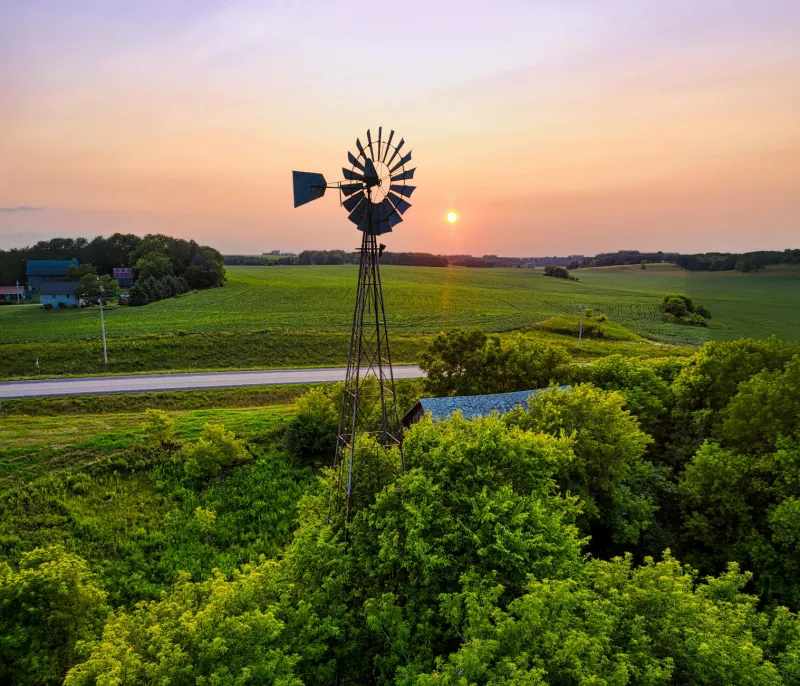
Red Sky at Night, Sailor's Delight
Your great-grandfather could tell you it was going to rain three days out just by watching how his chickens acted and feeling the pressure in his bad knee. No Weather Channel, no smartphone notifications, no satellite imagery spinning in colorful loops across a screen. Just decades of accumulated wisdom passed down through generations, wrapped up in rhymes that actually worked more often than you'd think.
In 1950s America, weather prediction was still largely a local art form. Farmers studied cloud formations with the intensity of today's meteorologists analyzing computer models. They knew that when smoke hung low to the ground, rain was coming. When cats washed behind their ears with unusual vigor, a storm was brewing. When the old-timer's joints started aching, you'd better bring in the laundry.
The official weather service existed, sure, but it was primitive by today's standards. Forecasts rarely extended beyond 24 hours, and even those came with the reliability of a coin flip. Weather reports arrived by telegraph from scattered observation stations, creating a patchwork of information that left enormous gaps. If you lived in rural Kansas, the nearest official weather station might be 200 miles away.
When Getting It Wrong Meant Everything
The stakes were brutally high. A missed forecast didn't just mean getting caught in the rain without an umbrella—it could destroy an entire year's crop, sink a fishing boat, or strand a family in a blizzard. Farmers planned their entire planting and harvesting schedules around weather patterns they had to read themselves. One wrong call about the last frost could wipe out a season's income.
Sailors and aviators developed their own sophisticated systems of weather reading. Pilots learned to spot wind shear by watching how clouds moved, because there was no ground control to warn them about dangerous conditions ahead. Ship captains studied wave patterns and bird behavior, knowing that a miscalculation could mean disaster.
The famous Blizzard of 1888 caught the entire East Coast off guard precisely because there was no system in place to track and predict such massive weather events. People went to work in mild weather and found themselves trapped in offices and schools as temperatures plummeted and snow piled up to second-story windows.
The Science Behind the Sayings
What's remarkable is how much folk wisdom actually worked. "Red sky at night, sailor's delight" isn't just poetry—it's based on solid meteorological principles about how light refracts through different types of atmospheric conditions. When your grandmother said her arthritis was acting up before storms, she was responding to real changes in barometric pressure that scientists now measure with precise instruments.
Animals really do behave differently before weather changes. Cows lie down before rain because they can sense the drop in air pressure. Birds fly lower when storms approach because the reduced air pressure makes it harder for them to maintain altitude. Cats and dogs become restless before thunderstorms because they can hear frequencies humans can't detect.
The problem wasn't that the old methods were wrong—it was that they were limited. Folk wisdom worked great for local, short-term predictions but couldn't handle the complex, large-scale weather systems that modern life demands we understand.
The Revolution in Your Pocket
Today's weather forecasting would seem like magic to someone from 1950. We have satellites orbiting the planet, taking pictures of storm systems from space. Supercomputers process millions of data points every second, creating models that can predict a hurricane's path five days out with startling accuracy. Your smartphone knows it's going to rain at 3:47 PM next Tuesday.
Doppler radar can show you exactly where precipitation is falling and how fast it's moving. Weather stations collect data from thousands of locations simultaneously, creating a real-time picture of atmospheric conditions across entire continents. The National Weather Service issues watches and warnings with precision that would have seemed impossible just decades ago.
But perhaps the biggest change is how weather prediction has shifted from a survival skill to a convenience feature. We check our phones to decide whether to bring a jacket, while our ancestors studied the sky to determine if their families would have enough food to survive the winter.
What We Gained and Lost
Modern weather forecasting has undoubtedly saved countless lives and prevented billions in economic losses. Hurricane evacuations, tornado warnings, and agricultural planning all depend on the sophisticated systems we've built. Airlines can route around storms, farmers can time their harvests, and you can plan your outdoor wedding with confidence.
Yet something was lost in the transition from intuitive weather reading to algorithmic prediction. The deep connection to natural cycles that our ancestors took for granted has largely disappeared. Most people today couldn't tell you what phase the moon is in, much less use it to predict tidal patterns or planting times.
We've traded the intimate knowledge of local weather patterns for the convenience of global forecasting systems. Your great-grandfather might not have been able to tell you what the weather would be like in Denver next week, but he could read the signs in his own backyard with an accuracy that came from a lifetime of careful observation.
The shift from folk wisdom to satellite technology represents more than just scientific progress—it's a fundamental change in how humans relate to the natural world around them. We've gained incredible predictive power, but we've lost the daily practice of reading the sky, feeling the wind, and trusting our own observations about the world we live in.