The Six-Week Love Letter: When Romance Required Patience and a Postmark
The Ritual of the Daily Mail
Every morning at 11 AM sharp, the postman's whistle would echo down Maple Street, and Sarah would rush to the front porch. Not for bills or advertisements, but for the cream-colored envelope that might contain three pages of her boyfriend's careful handwriting from two states away. In 1952, this was how love survived distance—one letter at a time, each one a small treasure that took six weeks to cross the country.
Today, we fire off "miss you" texts without thinking twice. But for most of American history, staying connected required something our generation has largely forgotten: patience, intention, and the lost art of putting real thoughts into real words.
When Words Carried Weight
Before the telephone became affordable for average families in the 1960s, letter writing wasn't just communication—it was the primary way Americans maintained relationships across any distance greater than a buggy ride. A single letter carried the emotional weight of dozens of today's text messages, because each one represented hours of careful thought and composition.
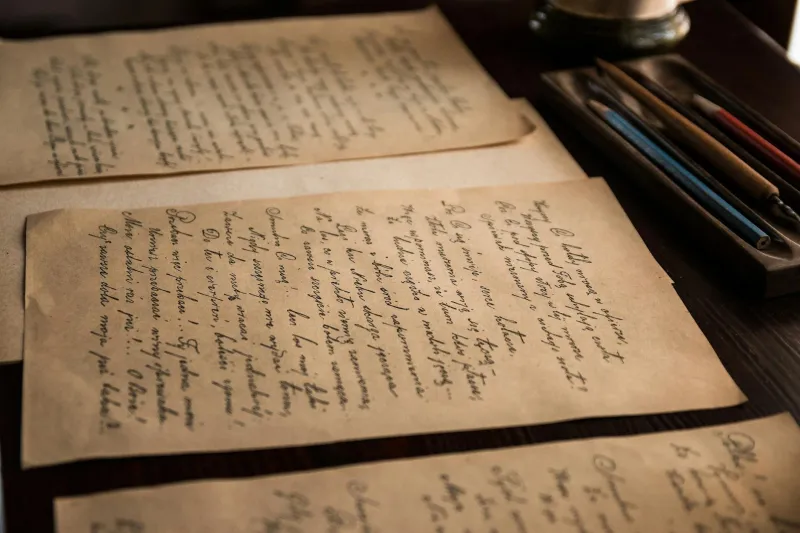
Consider what went into writing a letter in 1940. First, you needed quality stationery—cheap paper suggested you didn't value the recipient. Then came the actual writing, done in fountain pen with no delete key, no autocorrect, no chance to unsend an awkward phrase. Every word mattered because crossing out mistakes looked sloppy, and starting over meant wasting precious paper.
The physical act itself demanded focus. You couldn't dash off a letter while walking down the street or sitting in traffic. Letter writing required sitting down, clearing your mind, and dedicating uninterrupted time to one person. In our age of constant partial attention, this kind of focused communication has become almost revolutionary.
The Economics of Connection
A three-cent stamp in 1950 represented about 20 minutes of work at minimum wage—roughly equivalent to $6 today. This wasn't pocket change you'd throw away on casual thoughts. Each letter represented a small but meaningful investment, which made people choose their correspondence carefully.
Businessmen maintained extensive letter-writing relationships with clients across the country, building trust through consistent, thoughtful communication that could take weeks to complete a single conversation. A business deal that today might be concluded in a fifteen-minute phone call could stretch across months of careful correspondence, with each party having days to consider their response.
Families separated by westward migration or military service depended entirely on letters to maintain bonds. A mother in Boston might wait two months to learn her son had safely arrived in California, then another two months for his response to her worried letter. These delays created a different relationship with time and worry—you learned to live with uncertainty in ways that constant connectivity has made nearly impossible.
The Lost Intimacy of Slow Communication
Something profound happened in those days or weeks between sending a letter and receiving a response. The anticipation itself became part of the relationship. You'd replay conversations on paper, imagine your recipient's reaction, and carefully craft follow-up thoughts. This slow dance of communication created emotional depth that instant messaging, for all its convenience, struggles to match.
Love letters from this era reveal an intimacy that seems almost foreign today. Couples would write about their daily routines in detail, share philosophical thoughts, and express emotions with a vulnerability that's harder to achieve when you know your words will be read within seconds. The time gap created a safe space for deeper honesty.
Young people today send an average of 67 text messages per day, yet studies show they report feeling less connected to friends than previous generations. Perhaps there's something to be said for communication that required genuine investment of time and thought.
What We Gained and Lost
Today's instant communication has obvious advantages. We can maintain relationships across vast distances, coordinate complex plans in real-time, and share moments as they happen. Emergency communication that once took days now takes seconds, potentially saving lives and certainly reducing anxiety.
But we've also lost something irreplaceable: the art of sustained, thoughtful communication. Text messages train us to think in fragments, to respond immediately rather than reflectively. We've gained speed but lost depth, gained convenience but lost anticipation.
The physical letters themselves carried meaning beyond words. People saved them in shoeboxes, tied with ribbons, creating tangible archives of relationships. Today's digital messages disappear into the cloud, searchable but somehow less permanent, less precious.
The Handwriting on the Wall
By 1970, long-distance calling had become affordable for most American families, and letter writing began its slow decline. The 1990s brought email, which maintained some of letter writing's thoughtfulness while adding speed. But texting and instant messaging completed the transformation, turning communication into a constant stream rather than discrete, meaningful exchanges.
Today, the average American receives over 120 digital messages per day across various platforms. We're more connected than ever, yet somehow lonelier. Perhaps it's time to remember what our grandparents knew: that the best communication isn't always the fastest, and that some things—love, friendship, and understanding—develop better in the patient space between sending and receiving.