Smoking in the Locker Room: Why Yesterday's Pro Athletes Wouldn't Make Today's Rosters
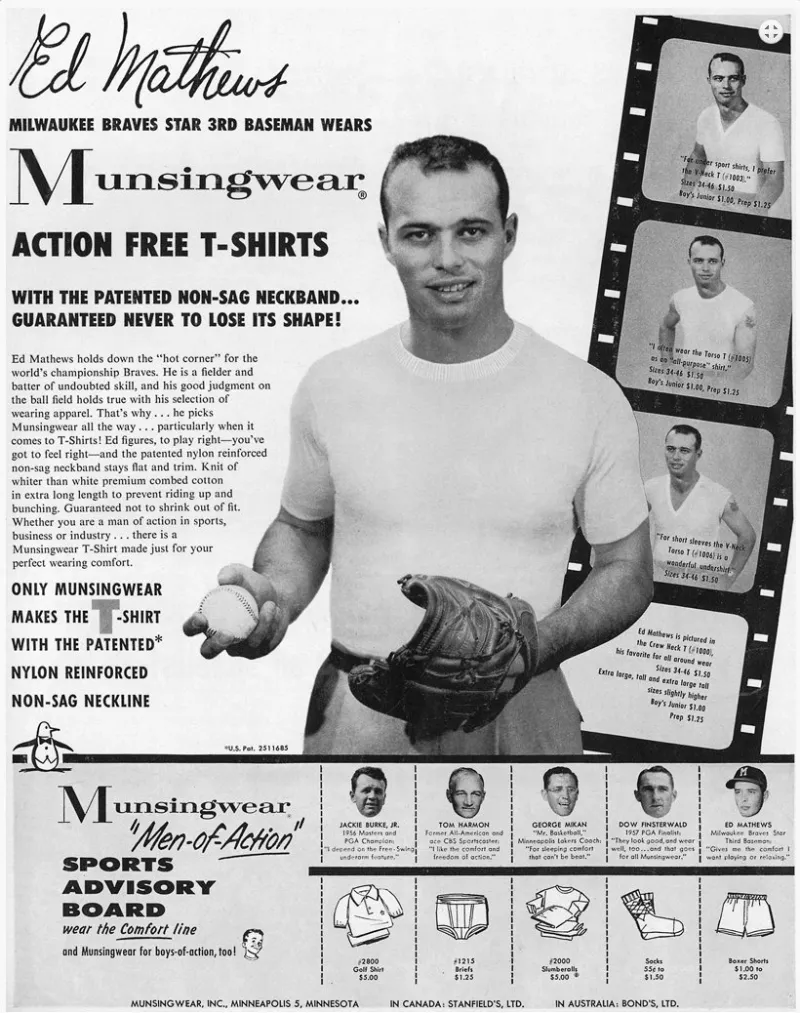
Photo: Munsingwear or advertising agency, Public domain, via Wikimedia Commons
It sounds like a joke, but it's documented history: professional athletes in mid-century America routinely smoked cigarettes, and not just after the game. Hall of Fame pitchers were famously photographed with a smoke in hand. College football players in the 1950s were given salt tablets and told to avoid water during practice, on the theory that drinking water caused cramps. One legendary NFL coach's training camp famously featured a pre-practice cigarette break.
These were the pinnacle athletes of their era—stronger, faster, and more skilled than anyone else alive at the time. And by every measurable standard, nearly all of them would be cut from a modern roster within a week.
The Season Was Part-Time, So Was the Job
Here's the part that surprises modern readers most: for most of the 20th century, being a professional athlete was not a year-round occupation.
Major League Baseball players in the 1950s reported to spring training in late February and played until early October. The other five months? Many of them went home and took a job. Selling insurance. Working at a sporting goods store. One future Hall of Famer spent his off-seasons as a plumber's apprentice. Training in the modern sense—weight rooms, nutrition programs, film study—barely existed. Many players believed lifting weights would make them "muscle-bound" and slow them down.
The numbers reflect it. In 1950, the average MLB player was paid around $13,000 a year—solid money, but not enough to skip a winter job. Compare that to today, where the league minimum is over $700,000 and the average salary sits north of $4 million. When your paycheck depends on your body 365 days a year, you train 365 days a year.
The Records Tell the Story
Look at the raw athletic numbers and the progression is startling.
The four-minute mile, once thought to be beyond human limits, was first broken in 1954. Today, high schoolers in a good program run under 4:10, and the world record has plunged below 3:43.
In the marathon, runners in the 1950s competed in leather-soled shoes and drank almost nothing during races. The world record then was around 2:20. Today it's under 2:01—and recreational runners routinely finish faster than the Olympic champions of the 1960s.
NFL players in the 1960s were, on average, around 6'3" and 240 pounds at the line positions—big men for their time. Today's offensive linemen average well over 300 pounds, and they're not just big; they run 40-yard dashes that would have been respectable for skill players two generations ago.
The Science Changed the Human
What happened? Three things, mostly.
First, sports science. Modern athletes are measured, scanned, and analyzed constantly—sleep trackers, blood panels, motion-capture cameras, force plates. A pitcher's throwing mechanics are broken down frame by frame. A sprinter's stride is optimized to the centimeter. Nothing is left to guesswork.
Second, nutrition and recovery. The idea that a professional athlete would smoke, or drink beer in the locker room after a game (which happened well into the 1970s and 80s), is now almost comical. Today's pros employ personal chefs, sleep coaches, and physiotherapists. Recovery is treated as seriously as training.
Third, and most importantly, the talent pool exploded. In 1950, America's professional leagues drew almost entirely from American-born athletes, and opportunities were limited by race, geography, and income. Today, the NBA recruits from every continent. MLB's rosters are a quarter Latin American. When billions of people instead of tens of millions are competing for a roster spot, the best athlete on Earth simply gets better.
Were They Tougher?
There's a nostalgic argument you'll hear at any sports bar: the old-timers were tougher, played through injuries, and didn't need a day off.
There's truth in it. Players routinely performed through injuries that would land a modern athlete on injured reserve for a month, partly because modern medicine can now detect the damage that used to go unnoticed. Old-timers played on worse fields, with worse equipment, in worse travel conditions—overnight trains, two-a-days in full pads in August heat.
But "tougher" and "better" aren't the same thing. Put a 1958 NFL receiver—no strength training, a pack-a-day habit, an off-season job—on the line against a modern cornerback who has trained since age 12 under professional supervision, and the contest isn't close.
The Ceiling Keeps Moving
The remarkable thing isn't that athletes got better. It's how fast. In two generations—less than the span of a single human lifetime—the absolute limits of human performance shifted by margins that once took centuries.
Somewhere right now, a 14-year-old is training with methods that don't exist yet. Forty years from now, today's MVPs might look to a new generation the way the cigarette-and-beer era looks to us: lovable, legendary, and hopelessly outmatched.