Must-See TV Was Must-See Because You Might Miss It Forever: What Happened When Entertainment Had a Schedule
Think about the last time you were genuinely excited to watch something. Not the low-grade, half-distracted consumption of scrolling through a service until something seems tolerable — but actually excited. Counting-down excited. Talking-about-it-at-work-on-Monday excited.
If you're under thirty-five, that feeling might be hard to locate. If you're over thirty-five, you probably remember exactly what it felt like, because it used to happen every single week.
And the reason it happened had almost nothing to do with the quality of the content. It had everything to do with the clock.
The Schedule Was the Contract
For most of television's history in America, the network schedule was a kind of social contract between broadcasters and audiences. You showed up at eight o'clock on Thursday, and the show was there. You missed it, and the show was gone — not paused, not waiting patiently in a queue, but genuinely gone, possibly until summer reruns, possibly forever.
That constraint sounds punishing from a modern perspective. Why would anyone prefer a system that punishes you for having dinner run late?
But the constraint did something valuable that we don't fully appreciate until it's absent: it created a shared cultural moment. On Friday morning in 1994, roughly forty million Americans had watched the same episode of ER the night before. They had the same reference points. They had the same unresolved cliffhanger living in their heads. Conversations at the office, at school, at the diner counter had a common starting point.
The schedule didn't just deliver content. It synchronized a culture.
The Ritual of the Rental Store
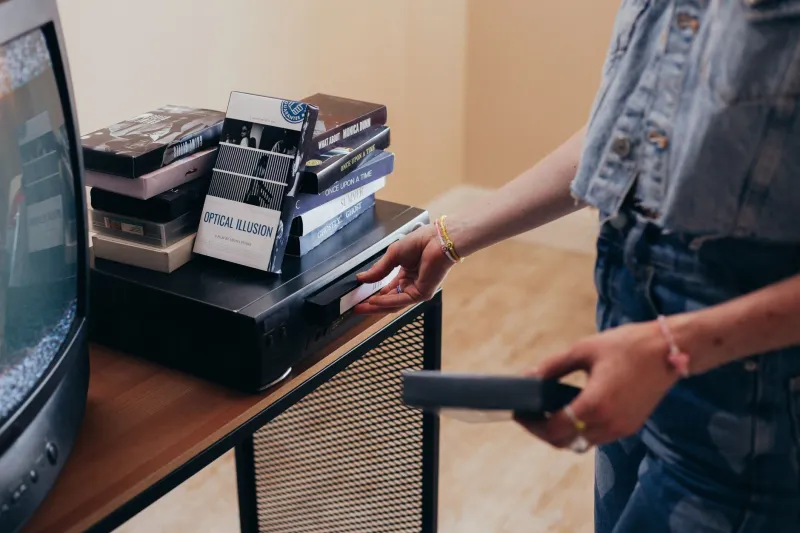
For movies, the equivalent institution was the video rental store — and if you grew up going to one, you understand that "going to Blockbuster" was never just a logistical errand. It was a Friday night event in itself.
You wandered the aisles. You debated. You picked something up, read the back, put it down, picked it up again. You discovered movies you'd never heard of based on nothing but cover art and a two-sentence description. You occasionally drove across town to a second location because your first choice was already rented out — which was both frustrating and, in retrospect, kind of wonderful, because it meant other people in your neighborhood had gotten there first and had opinions you might want to hear.
The store had hours. It closed. The new releases had a two-day return window, which meant your Friday night movie actually had a deadline attached to it, which meant you watched it rather than letting it sit on top of the television for three weeks like a good intention.
Scarcity, again, doing the work that infinite availability cannot do.
What Anticipation Actually Felt Like
There is a specific quality of anticipation that only exists when you cannot have something immediately. Anyone who waited a full week between episodes of a show they loved — not because of a streaming strategy, but because that was simply how television worked — knows the feeling.
You thought about it during the week. You replayed the previous episode in your head. You speculated about what would happen next. The gap between episodes was not dead time. It was active time. The show was living in your imagination, which is where stories do their deepest work.
Movie release dates operated the same way. A film came out on a specific Friday. If you didn't get to the theater that weekend, you might wait months before it showed up anywhere else. That scarcity made the opening weekend feel like a genuine occasion — something worth planning for, worth leaving the house for, worth standing in a line for.
The line, actually, deserves its own moment of appreciation. Waiting in line for a movie with friends was a social experience that preceded the entertainment itself. You talked. You speculated. You got increasingly invested in what you were about to see before you'd seen a single frame of it. By the time the lights went down, you were already committed in a way that passive at-home streaming rarely replicates.
The Paradox of Infinite Choice
Streaming services now offer catalogs that would have seemed science-fictional to someone standing in a Blockbuster in 1996. Thousands of movies. Hundreds of television series. Original content produced at a volume no single viewer could ever consume.
And yet the most common complaint about streaming, repeated so often it has become a cliché, is that there's nothing to watch.
This is not ingratitude. It's a real psychological phenomenon. When choices are limited, the brain commits to one and finds satisfaction in it. When choices are unlimited, the brain keeps scanning for something better, which means it never fully settles on anything. The technical term is choice overload. The lived experience is spending forty-five minutes browsing before giving up and rewatching something you've already seen.
The old system forced the decision for you. Thursday at eight, this is what's on. Your only real choice was whether to sit down and watch it. That constraint was not a limitation on your freedom. It was a release from the exhausting labor of constant choosing.
The Shared Calendar We Didn't Know We Had
What's hardest to recreate in the streaming era isn't the content — the content has genuinely never been better, by almost any measure. What's hardest to recreate is the simultaneity. The fact that millions of people were watching the same thing at the same time, on the same night, and would be able to talk about it together the next morning.
That shared calendar was a form of social infrastructure. It gave strangers a common reference point. It made water-cooler conversations possible across demographic lines. It created, episode by episode and season by season, a set of shared cultural touchstones that a generation could point to and say: we were all there for that.
Streaming has made entertainment more personal, more flexible, and more abundant. Those are real improvements. But personal and flexible means everyone is watching something different, on their own schedule, in their own silo.
We gained a universe of content and lost the shared room we used to watch it in.
Some Thursday nights, that trade feels less obvious than it did.